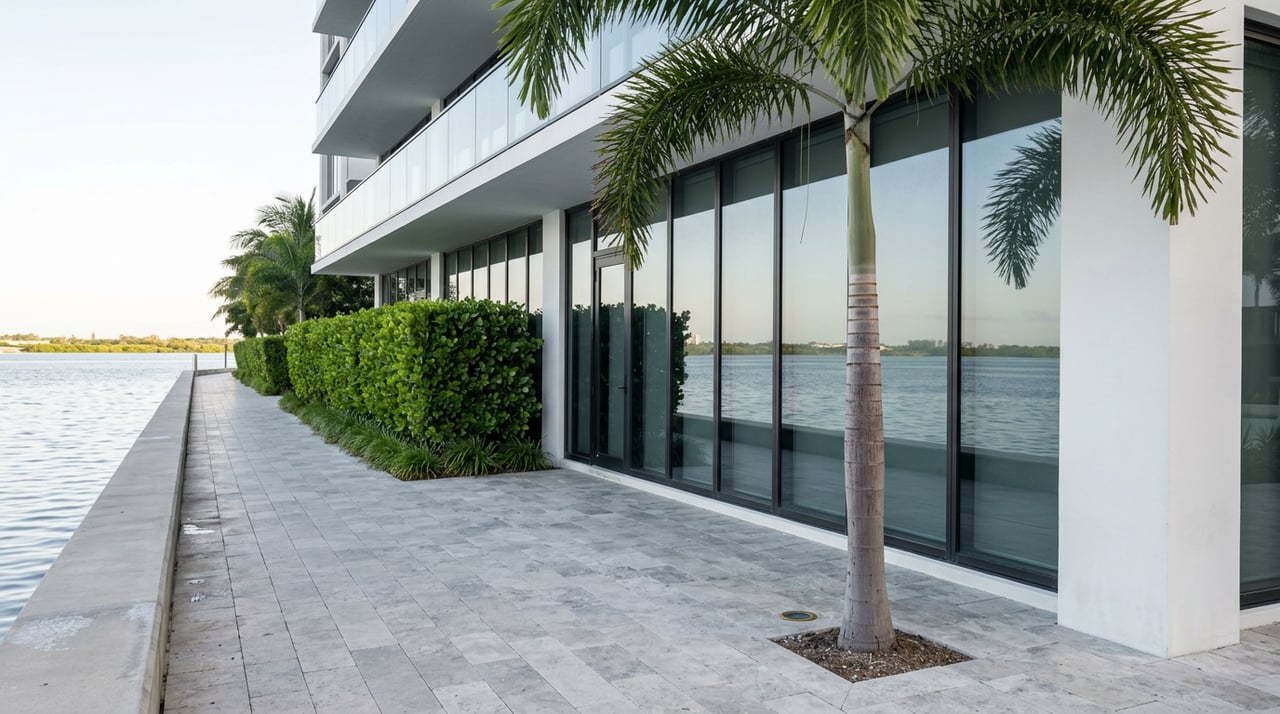
The tents go up at Margaret Pace Park a little after eight, canvas snapping in the bay breeze before the humidity sets in. By nine, the line at the coffee vendor curls past the flower stand, a woman is walking two dogs of wildly different sizes toward the fenced dog run, and somebody's toddler has already claimed a spot on the mosaic chairs near the water. None of this required a reservation or a drive across a causeway. It happens a few hundred feet from the front door of towers that, fifteen years ago, would have had no reason to expect a crowd like this on a Sunday morning.
That gap between the buildings and the street is the thing worth understanding about Edgewater right now. The neighborhood built up fast, glass tower after glass tower along the bay, and for a long stretch the ground floor didn't catch up. What's changed in the past year isn't a new restaurant or another groundbreaking. It's that Edgewater has assembled, almost building block by building block, an actual weekly rhythm at street level, and the person behind the biggest piece of it built it on purpose, as a direct answer to the exact problem the skyline created.
Three Markets, Three Different Reasons to Show Up
Ask five Edgewater residents where the neighborhood's social life happens and you'll get five different answers depending on which day you ask. That's not confusion. It's a real calendar.
| Day | Market | Where | What it's actually for |
|---|---|---|---|
| Friday, 4–9pm | Evening pop-up | Bayshore Drive | Food vendors and artisan goods, an after-work wind-down with the bay as backdrop |
| Saturday | Legion Park Farmers Market | Legion Park | The more established, longer-running market in the immediate area |
| Sunday | Margaret Pace Park Farmers Market | Margaret Pace Park | Produce, prepared food, and flowers, run as a weekly community gathering rather than a pop-up |
None of these three is trying to be the others. The Friday pop-up is built for people leaving work and not wanting to go straight home. The Saturday market at Legion Park has the longer institutional history in the corridor. Sunday at Margaret Pace Park is the one that's grown fastest and become the closest thing Edgewater has to a recurring town square, in a neighborhood that was never built with one.
The Woman Who Came Back for the Right Reason
The Margaret Pace Park market didn't arrive from a corporate events calendar. It came from Lucia Martinelli, who moved from Milan to Miami in 2015 and opened a food truck called Made in Italy in Edgewater in 2017, serving Neapolitan-style pizza, Angus beef burgers, and empanadas alongside co-founder and chef Juan Peñaloza. That truck was Martinelli's own introduction to what it takes to run a small food business in this city, and it's the reason her current market, launched through her company East Coast Marketplace, reads less like a real estate amenity and more like something built by someone who once needed exactly this kind of platform herself.
Martinelli has said plainly that the goal isn't transactional. She's described the effort as building community rather than building markets, and she's pointed directly at the thing Edgewater's rapid vertical growth produced: a population living in high-rises where daily life can feel disconnected from anything happening at street level. The Sunday market at Margaret Pace Park is her answer to that specific disconnection, not a generic amenity borrowed from another neighborhood's playbook. She also launched a second market, the Green Market on Flagler, this past February, which tells you the format is working well enough to replicate.
This is worth sitting with for a second, because it reframes what looks, from the outside, like a standard neighborhood farmers market. It isn't filling a gap that any neighborhood might have. It's filling the specific gap that comes from stacking thousands of residents into towers with no ground-floor plaza, and it was built by someone who'd already lived the harder version of that same problem as a small business owner with a truck and no fixed address.
What the Dog Park Actually Solved
If the market answers the "where do people gather" question, the dog park at Margaret Pace answers a narrower but equally real one: what happens when a mid-density waterfront neighborhood suddenly fills up with condo-dwelling dog owners who don't have yards.
The park's dog run is a half-acre, split into two fenced sections, one for dogs over 25 pounds and one for smaller dogs, with bench seating and water fountains for both the dogs and their owners. That's not a footnote. Splitting by size is the detail that keeps a shared, heavily used amenity from turning into a liability for the owners of smaller dogs, and it's the kind of design decision that only matters once you've actually tried to walk a ten-pound rescue through a run built for labradors.
The park around it does double duty for people without dogs too. Basketball, tennis, and volleyball courts sit near the water, an outdoor gym draws an early-morning crowd, and the paved waterfront promenade handles the joggers and stroller traffic that the market crowd doesn't absorb. It's a lot of function packed into roughly eight acres, and it's the reason Margaret Pace has become the default answer when someone new to the neighborhood asks where everyone actually goes.
The Baywalk Is Catching Up to the Street Life
The market and the dog park both work because they sit on land the city is actively investing in, not land that's simply been left alone long enough to feel established. Miami's broader Baywalk and Riverwalk plan, a four-mile waterfront promenade project decades in the making, runs directly through Edgewater on its way toward Downtown, and the city has continued pushing pieces of that funding forward specifically for the Edgewater segment.
Margaret Pace Park itself is mid-renovation under a phased master plan that includes a new upland seawall, an elevated Baywalk section built to handle storm surge and king tides, and a second phase with a community center whose construction is planned to begin in late 2026. None of that is finished yet, and residents who use the dog park or the courts regularly should expect construction fencing to move around the park over the next couple of years as phases roll out. But the direction is consistent: the city is treating this stretch of waterfront as infrastructure worth protecting and expanding, not a finished project.
Put together, the market calendar and the park upgrades tell a coherent story rather than a list of unrelated good news. Edgewater grew up as towers first, amenities second, and for years that order showed. What's happening now, market by market and phase by phase, is the ground floor catching up to the skyline, driven less by developer marketing than by a handful of residents and city planners deciding the street level deserved the same attention as the view.
If you already live here, none of this requires you to do anything except show up on the day that fits your schedule. If you're weighing whether Edgewater has settled into an actual neighborhood or just a very tall zip code, the answer is sitting in a half-acre dog run and a Sunday market that a former food truck owner built specifically because she'd felt the gap herself.
For questions about what's changing in Edgewater, whether you're already here or just watching from a distance, Vella Real Estate is always glad to talk through what it means for the neighborhood. Book an appointment whenever you're ready.
