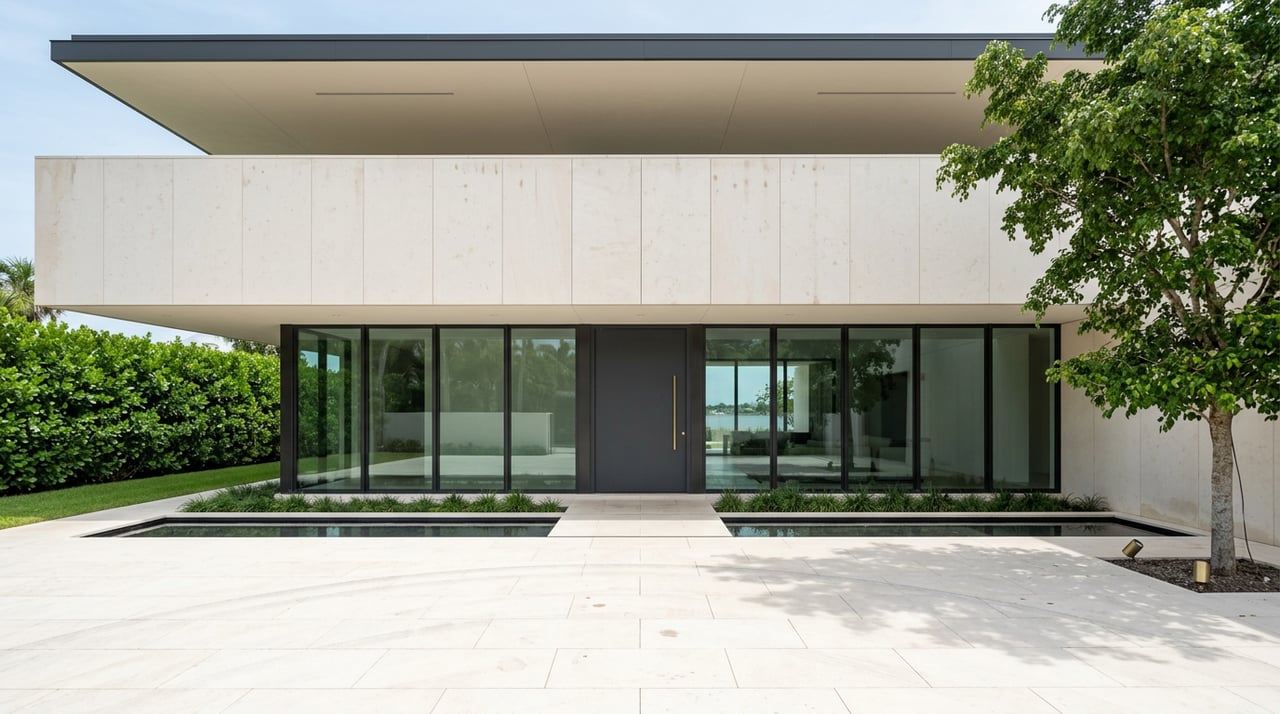
On May 11, 2026, an entity tied to Sean Combs issued a notice of default to John Franklin, the Virginia Beach buyer who had agreed to pay $55 million for 1 Star Island Drive. A second notice followed on May 13. In June, Franklin sued the seller, arguing the seller could not produce documentation on prior mortgages and permit matters and was not "ready or able" to close. The deal finally recorded in July, financed by an $18.5 million loan from Axos Bank, with the buyer taking title through JFStar LLC.
That sequence, reported by Rolling Stone and The Real Deal, is the friction most Star Island buyers never see. It is also the clearest recent illustration of a market that behaves nothing like the portals suggest.
The island has roughly 34 waterfront estates, one loop road, and one guarded gate. Read only the headline count and you would think a serious buyer has 34 options. Read the deed activity from 2020 through mid-2026 and a different picture emerges: one owner controls roughly a fifth of the island, most trades happen off-market, and the last publicly listed home was priced above $50 million. The functional inventory available to a new buyer is materially smaller than the address count implies, and that scarcity is doing more to set prices than any comp sheet.
One buyer, seven addresses, six and a half acres
Since 2020, Ken Griffin's entities have quietly acquired 8, 9, 10, 11, 12, 13, and 14 Star Island Drive. Robb Report, The Real Deal, and the New York Post put the assemblage at approximately $169 million across roughly 6.5 acres. Only 15 and 16 on that stretch remain in other hands.
Seven contiguous parcels on a 34-home island is not a rounding error. It is roughly 20 percent of the addresses and, because the lots are larger than the island average, a larger share of the land. Every future decision Griffin makes on that footprint (build, hold, expand) reduces or preserves the pool of homes the next buyer can realistically pursue. When Griffin filed in July 2026 for a private helipad at his separate 3.5-acre Terminal Island marina project at 120 MacArthur Causeway, it read to some observers as confirmation that his Star Island holdings are the long-term residential half of a two-site plan, with the boat and the aircraft parked across the water.
The 2026 comp set
The transactions that matter for Star Island pricing are not the ones on Zillow. They are these:
| Address | Price | Date | Notes |
|---|---|---|---|
| Doronin estate, Star Island | $120M | 2025 | Miami-Dade County record at the time; previously owned by Shaquille O'Neal |
| 1 Star Island Drive (Combs to JFStar) | $55M | July 2026 | Off-market; ~8,000 sf on 1.3 acres, 240 ft of bay frontage; $18.5M Axos mortgage |
| 43 Star Island Drive (Weiner) | $35.3M | Fall 2025 | 1.1-acre lot previously tied to Rosie O'Donnell |
| Ross estate refinance | mortgage raised to $35M | March 2026 | Same $35M he paid three years earlier, now cashed out |
Four data points in eighteen months. That is the entire relevant comp set, and three of the four never touched a public listing.
Why almost nothing lists publicly
PROFILEmiami noted after the Combs sale that off-market is "a common approach for many of South Florida's highest-priced residential sales, where privacy often takes priority over traditional public marketing." On Star Island the preference is closer to a rule. The island has a single controlled gate, no drive-through tourism unless a resident authorizes it, and an owner roster where discretion is part of the asset.
For a buyer, that has three practical consequences.
The first is that the portals are misleading by design. When The Real Deal reported the Doronin sale as a county record, no MLS listing had ever carried that price. The 43 Star Island Drive estate did surface publicly at $54 million in late 2024, but its eventual $35.3 million trade to Russell Weiner is the number that will comp future deals. The gap between asking and closing on the island's rare public listings is wider than portal data can capture.
The second is that access is relationship-priced. A buyer without a Miami advisor who knows which owners are quietly listening tends to see only the property that is already stuck on the market, usually for a reason. That is a poor basis for a $30 to $120 million decision.
The third is that even documented off-market deals can stall. The Combs to Franklin transaction was reportedly ready to close on May 12, 2026, and did not close until July, only after litigation and mortgage cleanup. A cash-rich buyer without lender scrutiny might have closed faster. A financed buyer, even at 34 percent leverage, still had to wait out the paperwork.
What Doronin's $120 million did to the rest of the island
Before 2025, the top Miami-Dade residential sale on record was Griffin's own $106.9 million purchase of the Adrienne Arsht estate in Coconut Grove, per MSN and Robb Report. Doronin's $120 million Star Island sale reset that ceiling. It also reset seller psychology on the island.
Compare the two 2026 trades:
- 1 Star Island Drive traded at $55 million on 1.3 acres with 240 feet of frontage. That works out to roughly $42 million per acre and around $229,000 per linear foot of water.
- 43 Star Island Drive traded at $35.3 million on 1.1 acres in fall 2025. Roughly $32 million per acre.
Neither price is a bargain, but both were signed after the Doronin ceiling was public. When the top of the market moves from $107 million to $120 million, sellers of the next tier down mark up expectations accordingly, whether or not the improvements justify it. For a buyer, the practical question becomes: which of the recent trades reflects real value, and which reflects a comp chosen from a very small sample?
The friction the Combs sale exposed
Three specific frictions surfaced in the Combs to JFStar file that are worth naming, because they generalize to almost any Star Island transaction of size.
Mortgage clearance on legacy debt. According to Rolling Stone's coverage of the Franklin complaint, the buyer alleged the seller could not initially document the status of prior mortgages, including a Northern Trust loan. On trophy waterfront, prior owners often layer refinancings across decades. Title cannot deliver clean without every payoff letter accounted for.
Permit history. The same filing references "prior permit-related matters." Star Island homes built in the 1940s and expanded in the 1990s (1 Star Island Drive is a 1940 structure expanded in 1995, per The Real Deal) often carry open or ambiguous permits. Buyers who plan renovations inherit that history.
Timing between agreement and close. The Combs deal slipped from a May 12 target to a July close. On an island where owners are watching each other's timelines and news cycles, a two-month delay can invite a competing offer, a price re-trade, or, as here, litigation.
None of these is unique to Star Island. All of them show up more sharply here because the deals are bigger, the parties are more scrutinized, and the pool of qualified buyers who can substitute in is small.
What this actually means if you are shopping Star Island
Start by discarding the "34 homes" mental model. The realistic pool is closer to two dozen, and in any given twelve month window perhaps two of those change hands. A buyer who is serious about the address is really shopping a queue, not a market.
Assume the property you want is not listed. Doronin, Combs, Weiner, and the recent Estefan trades were all off-market or effectively so. A public search will surface the outliers and miss the actual opportunity set.
Price the friction in. Between legacy mortgages, decades-old permit files, and the small-sample comp problem, closings on Star Island are more likely to be re-traded, delayed, or litigated than closings elsewhere in Miami Beach. Budget for a longer diligence window and a title team that has cleared island files before.
Watch what Griffin does next. His seven-parcel footprint and his Terminal Island marina application are the single biggest variables on the island's supply side. Whatever he builds, keeps, or eventually releases will shape the comp set for the next decade.
FAQ
How many homes actually trade on Star Island in a typical year? Public reporting from The Real Deal and PROFILEmiami shows a handful of notable trades between 2024 and mid-2026, most off-market. One to three closings per year is a reasonable planning assumption, though not every closing is publicly reported at signing.
Is Ken Griffin's assemblage for sale? Nothing in the public record suggests it is. Griffin has spent roughly $169 million assembling the seven parcels since 2020, per Robb Report and MSN, and continues to invest in adjacent Terminal Island infrastructure.
Do Star Island trades ever use financing, or is it all cash? Both. The July 2026 sale of 1 Star Island Drive was financed with an $18.5 million Axos Bank mortgage against a $55 million price, roughly 34 percent leverage. The original 2021 purchase carried a $20.7 million Bank of America loan. Financed trophy deals happen; they simply take longer to clear.
What was the county record before Doronin's $120 million sale? Griffin's own $106.9 million purchase of the Arsht estate in Coconut Grove in 2022.
If you are evaluating Star Island or one of Miami's other single-gate waterfront enclaves and want a candid read on which homes are actually reachable, the queue behind them, and how recent trades should shape your offer, Vella Real Estate works these transactions the way they get done here: privately, patiently, and with the paperwork sorted before the price is agreed. Book an appointment when you are ready to talk specifics.
