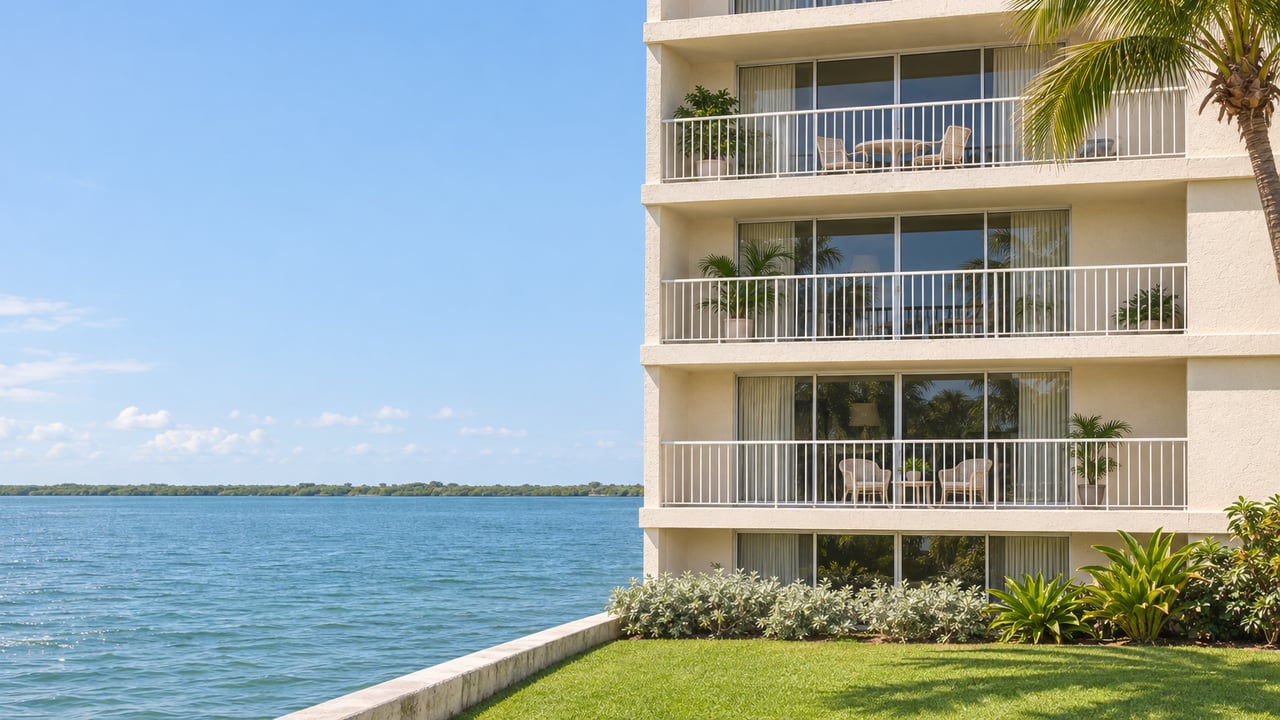
Biscayne 21 is a 1964 condominium at 2121 North Bayshore Drive in Edgewater. Over the course of one buyout, its units were valued at five very different prices. The appraisal attached to the developer's plan of termination put the holdout owners' units at $300,000 to $650,000, according to the owners' 2023 complaint. The 2022 bulk purchase averaged about $785,000 a unit, by The Real Deal's math. Ten owners of eight units did not sell. On August 31, 2026, they settled with Two Roads Development for about $50 million combined. The Real Deal put that at roughly $6.3 million per ownership, counting each of the two couples as one owner.
The units were similar. Two things made the prices different: a voting rule written into the building's declaration in 1974, and how long the developer was willing to carry its debt while that rule was fought over in court. Anyone comparing older bayfront buildings in Edgewater with the new towers can learn something from that, because in an older building the declaration is part of what you buy.
One building, five prices
| Price point | Who received it or proposed it | Basis |
|---|---|---|
| $300,000 to $650,000 per unit | Appraisal in the plan of termination for the holdouts' units | Owners' complaint, 2023 |
| About $785,000 per unit, on average | Owners who sold in the May 2022 bulk deal | $150 million total, per The Real Deal |
| Nearly $1.3 million | Offer to one owner of a renovated bay-view three-bedroom, early 2021 | The Real Deal, September 2026 |
| Up to $1.5 million, or $1,805 per square foot | The developer's highest disclosed unit purchase, as recently as August 2022 | Owners' complaint, 2023 |
| About $6.3 million per ownership | Holdouts in the August 31, 2026 settlement, each couple counted once | The Real Deal, September 2026 |
The complaint also argued that the appraisal looked at the wrong asset. It said the developer had bought 182 units and that about 90 percent of those purchases closed above the $650,000 top of the appraised range. The owners also argued that the land under the building, valued as a development site, was worth at least $500 million. By their math, that came to more than $2.5 million per unit. That was the owners' position in the lawsuit, not a finding of the court. Still, it names the gap that the rest of the case turned on. The complaint valued the planned project at $1.5 billion to $2.5 billion.
The clause that set the top price
Biscayne 21's declaration was recorded on December 10, 1974. It adopted the law in force at the time, which required the unanimous agreement of unit owners to terminate the condominium. Its amendment article allowed most changes with 51 percent of owners. Any amendment "altering . . . the voting rights of any of the Owners" required 100 percent.
After the bulk purchase, the developer-controlled board amended the declaration in August 2022 to lower the termination threshold from unanimity to 80 percent. The association then approved a termination plan in September 2022. The Third District Court of Appeal later held that the amendment was invalid. Its revised opinion of July 10, 2025 begins plainly:
"Unit owner Angelica Avila and several other unit owners at the Biscayne 21 Condominium didn't take the money."
The court gave two reasons. First, moving the termination threshold from 100 percent to 80 percent changes owners' voting rights, so the declaration's unanimity requirement for such changes applied. Second, the declaration lacked what Florida courts call Kaufman language, after Kaufman v. Shere from 1977. That is wording that would have automatically brought later changes in the statute into the declaration. Without it, the 80 percent floor in current law did not override the 1974 document. Every remaining owner at Biscayne 21 kept a veto.
How a veto turned into leverage
The ruling gave the holdouts their veto, and the calendar made it expensive for the developer to wait them out.
- May 2022. Two Roads buys most of the units for about $150 million, financed with a $105 million senior mortgage from Bank OZK and a $45 million mezzanine loan.
- September 2022. Sales open for the 55-story, 185-residence EDITION tower, starting at $1.7 million.
- May 2023. Ten owners sue. That summer the building's air conditioning fails, and the building is later declared uninhabitable.
- March 2024. The appeals court reverses the denial of an injunction. The developer seeks rehearing, which the court denies in July 2025.
- December 2024 and January 2025. Two Roads offers $20 million up front plus a deferred payment tied to future EDITION sales. The holdouts ask for $51.1 million.
- October 2025. The Florida Supreme Court declines to hear the case.
- January 2026. Circuit Judge Thomas Rebull orders the building and common elements restored to their May 2023 condition and bars the developer from seeking zoning approvals or demolition permits. Two Roads' own estimate of the restoration cost is about $61 million.
- August 31, 2026. A settlement of about $50 million is reached and funded. According to the Miami Herald, the developer's separate termination suit is dismissed as part of the deal.
Through all of this, according to The Real Deal, Two Roads was paying interest in the millions of dollars on the loans tied to the 2022 purchase. Once a restoration bill of about $61 million was a real possibility, a $50 million settlement looks like the cheaper option rather than a surrender.
Robert H. Murphy, one of the holdouts, told The Real Deal that in early 2021 he had asked for about a third more than the nearly $1.3 million offered for his renovated unit. In his view, the developer "could have avoided everything that happened by paying me and my neighbor a combined total of $600,000 to $700,000 above the bulk sale price." Over five years, a gap of under $1 million turned into a $50 million settlement.
Florida legislation and Biscayne 21
HB 913 took effect July 1, 2025, and mostly dealt with inspections, reserves, and association governance. It did not change the termination threshold. In the 2026 session, HB 657 and SB 1498, two broad community association bills, both died on March 13, 2026. According to The Real Deal, both sides of the Biscayne 21 case have asked the Legislature to act. Taylor Collins of Two Roads called for "a clear, fair and predictable process for terminating condominium associations." Glen Waldman of Armstrong Teasdale, who represented the holdouts, answered: "This was not a sick building. They had just put $6 million into it." As The Real Deal reported in 2023, the owners' complaint says the building finished its 40-year recertification in 2017 after about $6.4 million in repairs funded by special assessment.
The records at the center of the Biscayne 21 case
The Biscayne 21 case brought several parts of an older building's records to the center of the dispute.
- The termination clause in the declaration. At Biscayne 21, the clause required unanimous agreement.
- The amendment article. Biscayne 21's required every owner's approval for any change to voting rights.
- How the declaration refers to the statute. The Third DCA ruled on whether Biscayne 21's declaration brought in later statutory changes, which is the Kaufman question.
- Who owns the units. At Biscayne 21, one investor's company began buying units in 2015 and had gathered 48 by the time of the Two Roads deal.
- Recertification and assessment history. Biscayne 21's 2017 repairs later became evidence in the argument over whether the building had reached the end of its useful life.
Where the EDITION project stands
With the settlement funded, Two Roads now controls the full 3.5-acre site. Commercial Observer reported that the project was 40 percent presold as of early September 2026. The developer's project page lists residences from one-bedroom-plus-den to four bedrooms, 1,952 to 3,864 square feet, priced from $1.7 million. In April 2026, three buyers who had signed for five units in spring 2023 sued to recover about $2.5 million in deposits. Their contracts had projected completion by summer 2028, a date set before the settlement.
FAQ
Did the holdouts get about $6.3 million per unit because their units were worth more? No. The roughly $6.3 million per ownership was a settlement figure. It came after courts upheld their veto and after the developer faced a restoration estimate of about $61 million.
Did the post-Surfside repair rules force Biscayne 21's sale? The owners first put the building on the market in early 2020, before the Surfside collapse.
If you own in an older Edgewater building, or are weighing one, we can go through its ownership pattern and sales history with you. Vella Real Estate can help. Book an appointment.
